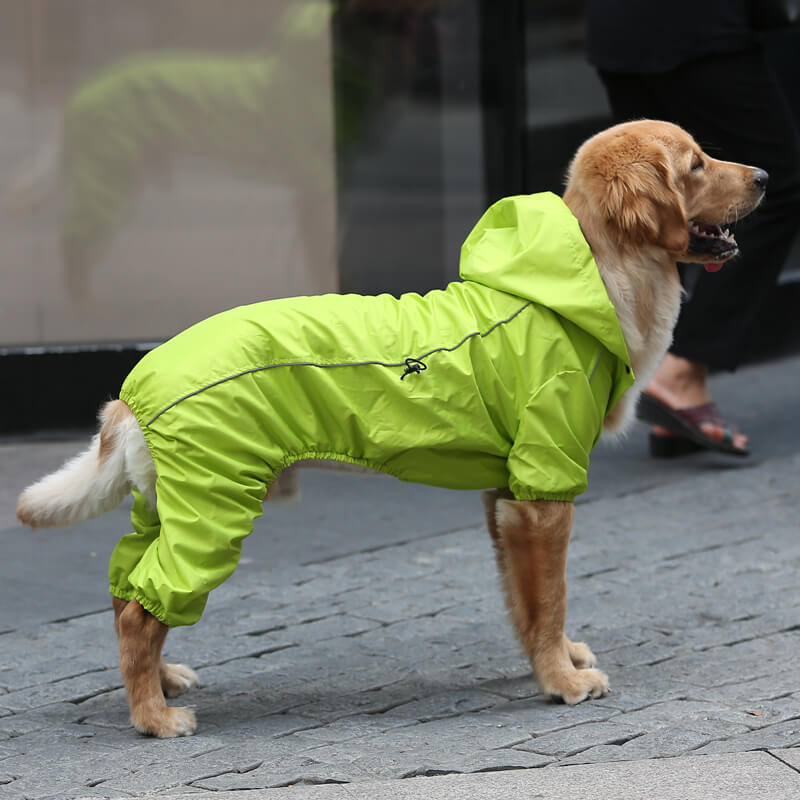
A dog raincoat is an assembly of materials, seams, closures and openings fitted around a moving body. Its sourcing specification needs to connect those parts with measurement methods, sample versions and evidence for any proposed performance wording.
For a brand, importer or wholesale buyer, the practical question is what the supplier’s quotation and sample actually represent. A clear answer makes comparison useful. It also identifies the decisions still open before the next sample, reference approval or production commitment.
Define the Raincoat Before Comparing Suppliers
Start with the intended use and exposure. Describe the anticipated rain conditions, coverage and garment format, together with exclusions. A brief for a back-covering shell leaves different opening and clearance questions from a one-piece design. State whether collar or harness access is needed and which adjustments matter to the proposed range.
Keep uncertain requirements visible. If the desired water-performance claim has no agreed evidence basis yet, mark it for discussion. Ask each supplier to distinguish the requested construction from its proposed alternative, so quotations remain comparable.
Separate range selection from technical approval. The dog clothing range can help identify commercial product directions. The sourcing brief then needs a particular design reference, intended size assortment and list of unresolved requirements. A product photograph can identify a shape; it leaves hidden construction and performance questions open.
Specify the Material System and Its References
Identify the substrate, coating, film and finish
A quotation labeled polyester, nylon, PU, TPU or PVC is incomplete until the role of each material is clear. Ask for the supplier’s material reference and construction description, including relevant composition, weight, thickness and layer information.
An applied PU coating, a bonded film laminate and a surface water-repellent finish describe different treatments or assemblies. Covestro’s functional-textile examples distinguish coating systems from functional and adhesive films. Its lamination explanation describes bonding layers. These examples explain vocabulary without establishing the performance of a proposed raincoat.
| Quoted item | Clarify in the specification | Still needs evidence |
|---|---|---|
| Polyester or nylon substrate | Composition, construction, weight and article reference | Any claimed water or durability result |
| PU coating | Identified coating system, side and relevant weight or thickness | Performance of that coated substrate |
| TPU film or laminate | Film grade, role, bonded layers and assembly reference | Claimed property of the actual assembly |
| PVC construction | Sheet, coating or composite; composition and layer identity | Product-specific performance and suitability |
| Surface finish | Treatment reference and represented care condition | Surface-wetting result within its stated scope |
| Lining | Composition, coverage and attachment | Any claimed property of the complete assembly |
| Trim and components | Component identity, position, attachment and care reference | Claimed function and durability within that scope |
TPU can serve different roles, including functional or adhesive films, as Covestro’s textile applications illustrate. Neither the polymer name nor a higher layer count establishes a superior coat.
For a specific commercial reference, identify the VD03 one-piece dog raincoat in the enquiry. Confirm the proposed order’s construction separately; the product reference alone establishes no tested rating.
Record lining, trim and component requirements
Specify lining composition, coverage and attachment where included. Mesh openings in one layer cannot establish water-vapor transport through the complete assembly. Adding fleece or insulation introduces a separate thermal brief and evidence task.
Identify thread, binding, reflective trim and branding components with their locations and attachment references. Record relevant care requirements across these components. This avoids approving an outer material while leaving the rest of the assembly undefined.
Match Weather-Performance Claims to Evidence
Separate surface repellency, penetration resistance and garment claims
Water-repellent, water-resistant and waterproof wording needs a defined property and object. Agree what the wording is intended to describe before comparing results.
| Proposed wording | Relevant evidence question | Limit |
|---|---|---|
| Water-repellent | What surface-wetting result applies to this fabric and condition? | Beading leaves penetration and garment performance unproven. |
| Water-resistant | What resistance was measured, on which specimen, under what exposure and criterion? | The term supplies no universal grade by itself. |
| Waterproof garment | What defined exposure and evidence cover materials, seams, closures and openings? | A fabric result alone cannot establish the whole-coat claim. |
AATCC TM22 addresses fabric resistance to surface wetting under spray. AATCC TM127 addresses water penetration under hydrostatic pressure; its summary distinguishes those results from rain or spray methods. These references answer different questions. Neither supplies a universal dog-raincoat acceptance threshold or a finished-garment certificate.
Define breathability, wind and reflective requirements
Ask which transport property breathable refers to. ISO 15496 concerns water-vapor permeability for quality control, with limits on physiological interpretation and comparison with other methods. Fabric air permeability has a separate reference in ISO 9237. A water result or polymer label cannot establish windproof wording; clarify airflow evidence and garment openings.
For reflective details, identify whether retroreflection is intended. 3M’s component explanation describes returning incident light toward its source. Request evidence for the actual trim, placement, attachment and care condition. This function carries no automatic accident-prevention or whole-garment certification promise.
Break weather protection into specific exposure, coverage and evidence requirements. Material results alone support no canine comfort, health or overheating claim.
Review Seams, Closures and Openings as One Assembly
Stitched, taped and welded seam references
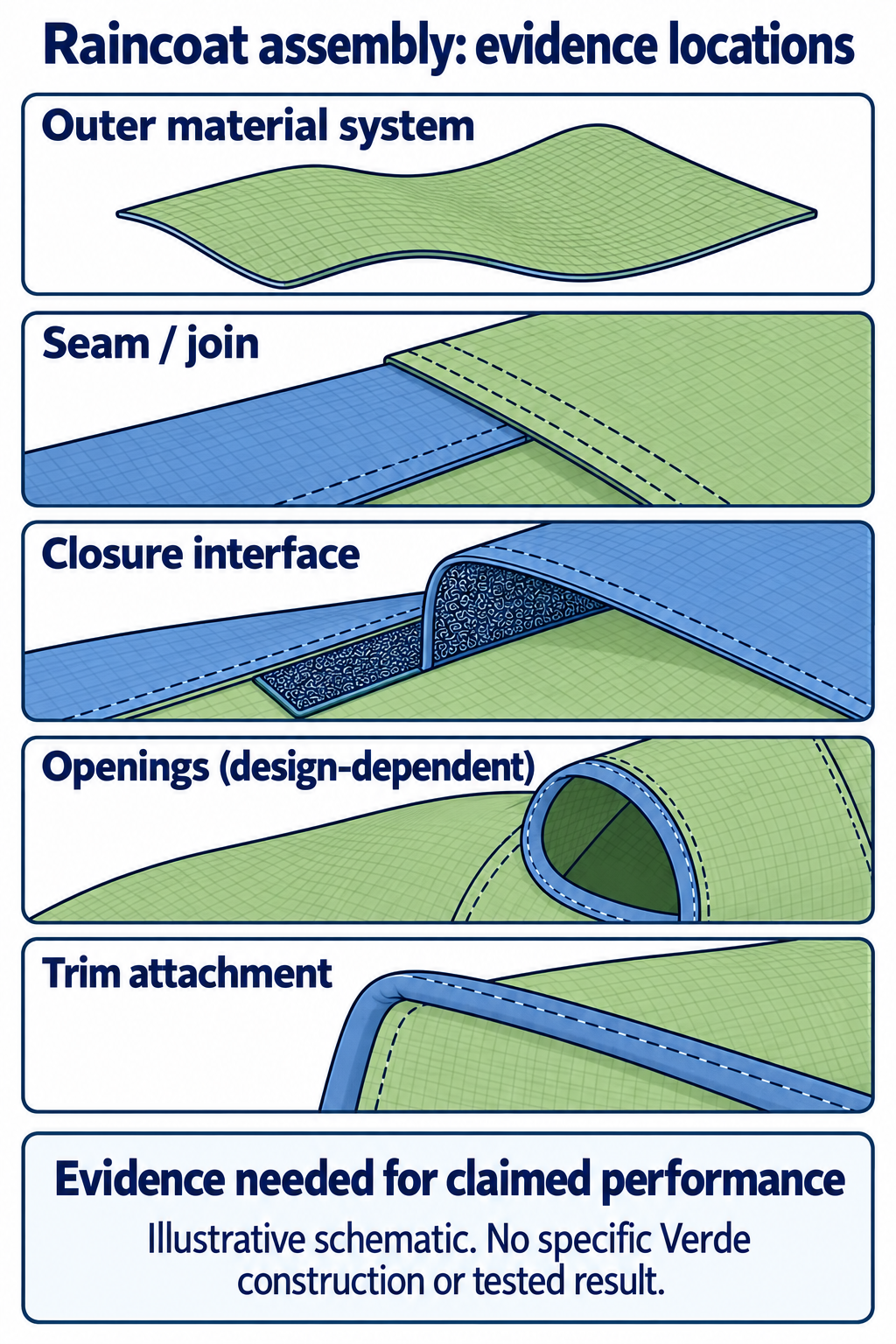
Map the joins and their locations. A stitched join introduces needle penetrations that require separate consideration from the base fabric. Specify the seam and thread references, then inspect alignment, skipped or broken stitches, puckering and visible damage against agreed criteria.
If seams are described as taped or sealed, identify the treatment, substrate and exact locations, including intersections and ends. Bemis’s seam-tape information illustrates sealing stitched seams with substrate-compatible systems. Missing coverage or lifting is a sample-review concern; neat tape appearance leaves bonding durability and water performance unproven.
For welded joins, request the represented materials, joining process and joint geometry. Covestro’s welding explanation concerns specified film materials and fusion processes. Applicability needs confirmation for the proposed assembly. Check continuity, distortion and damage without treating a visual review as joint-performance validation.
Binding finishes an edge and does not automatically seal it. Topstitching, sewn branding and reflective attachments also belong on the construction map because they change the represented assembly.
Closure, hood and opening details
Record closure type, position, overlap, backing and attachment. On a zipper, snap or hook-and-loop sample, observe operation, alignment, gaps and distortion. Hardware material alone supplies no safety or service-life conclusion.
Define hood or collar geometry where present, neck adjustment, belly coverage, leg and tail openings, and collar or harness access. Each needs a reference for coverage and clearance. Wider enclosure can create movement conflicts; the design brief must resolve that trade-off. No single hood or opening arrangement suits every project.
Make Fit and Sizing Repeatable
Body references and finished-garment measurements
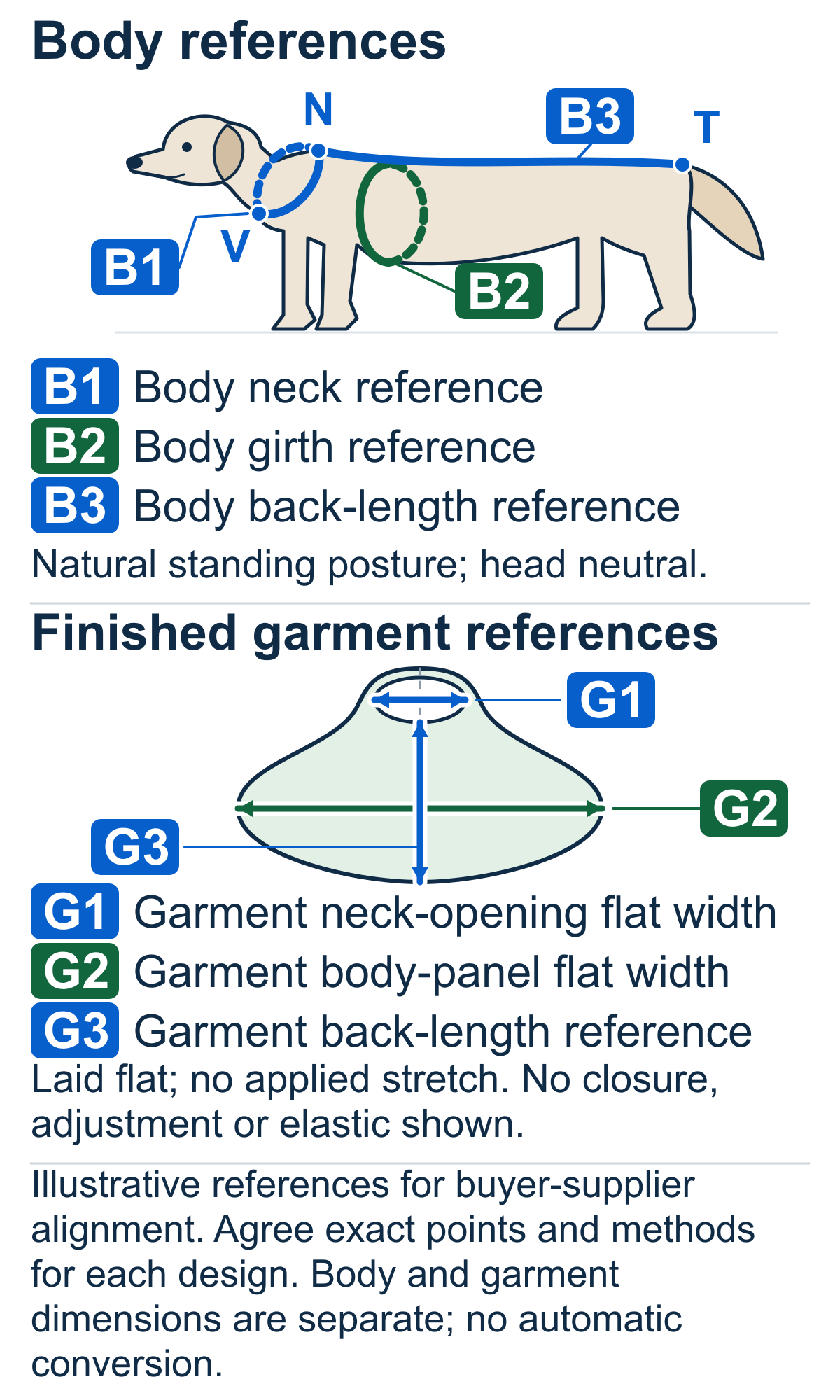
Keep two measurement records. Body references describe the intended wearer range, using defined neck, chest/girth and back-length landmarks, posture, tape method and units. Finished-garment points describe the coat itself, using a diagram and stated condition, such as laid flat, fastened and adjusted to an identified setting.
Explain how curved, elastic or adjustable points are measured. If a circumference is derived from a flat dimension, identify the calculation and method. Body and garment numbers have different purposes; their relationship needs pattern and sample confirmation.
Size range, tolerance and fit confirmation
Agree the size set, critical points, grading increments and adjustable ranges. Review dimensions individually across sizes and record any size-specific exceptions. Set dimension-specific tolerances with the supplier, tied to the agreed method and disposition of deviations.
Fit review connects neck and girth adjustment, back and belly coverage, and leg, tail and toileting clearance with the actual pattern. Record the sample version, size, settings and represented body references. Observe movement and interference responsibly; stop an unsuitable fitting if restriction or distress appears. No animal exposure test is needed for this guidance.
Breed names, weight bands, size labels and one satisfactory fitting cannot guarantee fit across the intended population. Body-shape variation remains a size-range review question. Preserve the same measurement method through revisions and production checks.
Review Samples by Stage and Version
Give every sample an identity, date, version and stated purpose. Establish which materials, sizes, colors and features it represents before deciding what can be approved.
| Stage | Decision supported | Boundary |
|---|---|---|
| Development sample | Explore concept, materials and construction | List unrepresented features and open requirements. |
| Revised sample | Review identified changes and affected interfaces | Other open items remain open. |
| Approved reference sample | Retain an identified, authorized reference | Approval covers stated features and conditions. |
| Pre-production confirmation | Reconcile intended bulk materials, versions, assortment, labels and packing | Resolve remaining differences and evidence needs. |
| Bulk production | Work against agreed references and controls | One sample cannot guarantee every unit. |
| Final inspection | Assess a defined lot and inspection scope | Acceptance remains bounded by criteria and scope. |
A useful sample record groups observations and evidence requests as follows.
- Material and layers: match article references, coating or film identity and lining to the proposal.
- Seams and attachments: compare mapped joins, treatments, branding and visible defects with the reference.
- Dimensions and settings: record the method, actual measurements, adjustment and coverage observations.
- Closures and trim: check positions, operation and component versions, including reflective details.
- Labels and packing: compare artwork, placement, quantities and presentation with the agreed version.
- Evidence and decisions: link reports, comments and open items; name the responsible person and next decision.
Use accepted, revise or unresolved for the agreed review items. Record what changed between versions and recheck affected interfaces. For example, a closure-position revision may require renewed overlap and measurement review. Retain those comments with the sample record so the next approval has an explicit scope. An approved reference establishes what was agreed; bulk acceptance remains a later decision.
Evaluate Supplier Evidence and Approval Responsibilities
Compare the specificity of supplier responses. A useful response identifies the proposed construction, reconciles component and dimensional references, and separates confirmed details from missing evidence. Attractive presentation alone leaves those questions unanswered.
Keep five evidence objects distinct. A supplier claim states an assertion. A specification states a requirement. A test report records results for identified specimens and conditions. A sample observation records what was seen or measured. A production inspection records findings within a defined inspection scope. Moving between these objects requires an applicable basis.
For each relevant report, check issuer, report identity and date, method and edition, specimen material, color and assembly, conditioning or care history, units, result and agreed criterion. Match these details to the proposed claim. A report for another material or an unconditioned specimen may leave the actual requirement unresolved. A document logo cannot settle applicability.
Ask durability questions by failure mode. ISO 105-X12 addresses color transfer through dry and wet rubbing. Washing, abrasion, tearing, seam-tape adhesion, closure endurance and retained water resistance are separate questions. Request evidence relevant to the intended care claim and the actual coating, tape, print and trim combination. No single result establishes service life.
Name who may approve the specification, reference sample, changed items, claimed evidence and lot disposition. If necessary evidence is missing, hold the affected decision as unresolved. Destination-specific product, labeling or claim compliance may need separate qualified review; these technical references establish no mandatory dog-coat legal regime.
Verde’s product-development approach accepts a sample, photo, drawing, measurement chart or early idea for discussion and describes reviewing materials, construction, sizing, branding and packing before sampling. This is general process context, with no raincoat-specific test capability implied. For cross-category sourcing decisions, see the broader pet clothing manufacturer evaluation.
Keep Bulk Production Tied to Approved References
Carry the approved sample identity and specification versions into the production agreement. Reconcile the material and component references, size/color assortment, labeling, finishing and packing. Agree the control points, inspection scope and handling of deviations for the actual order.
Treat substitutions as decisions. A proposed change in coating, tape, closure, reflective trim or attachment may affect several references. Identify the changed item, review the affected measurements and interfaces, and determine what evidence or renewed approval is required before accepting the change. Preserve the superseded reference in the record.
Define the lot, selection or sampling scope, criteria and authorized disposition for final inspection. Keep observed nonconformities traceable to the reference and record whether the response is correction, further review or another agreed disposition. Neither sample approval nor a bounded inspection guarantees every unit or lifetime performance.
Prepare a Comparable Raincoat Enquiry
Send the same starting information to each supplier and ask for explicit departures or alternatives. Use what is available; identify the missing pieces without waiting for a completed tech pack.
- Reference sample, photos, drawing or available specification, with intended use, market and exclusions.
- Proposed materials, layers, weather-performance wording, seam requirements and evidence questions.
- Body and garment measurement references, size assortment, closures and access requirements.
- Reflective details, branding, labels and packing, with available artwork or unresolved choices.
- Quantity, size/color split and desired timing, clearly marked as project inputs for confirmation.
Ask the reply to distinguish confirmed scope, assumptions, alternatives and open decisions. Price, minimum order quantity, sampling arrangements and delivery feasibility require project-specific agreement.
Good dog raincoat sourcing leaves a traceable path from the requested product to the evidence and reference being approved. That path makes differences visible and keeps the next commitment proportional to what is actually known. Share the available references and open questions to Discuss Your Dog Raincoat Specification.