A cat clothing sample review should end with a recorded decision to approve, conditionally approve, or request revision. Whether you represent a pet brand, importer, wholesaler, or product team, that decision needs a defined sample, clear comparison references, and evidence for the next stage.
Use the following sequence for development, fit, size set, or pre production samples. It connects what you inspect with what you authorize, so the supplier can act on a clear record.
Define the Sample Decision and Control the Review References
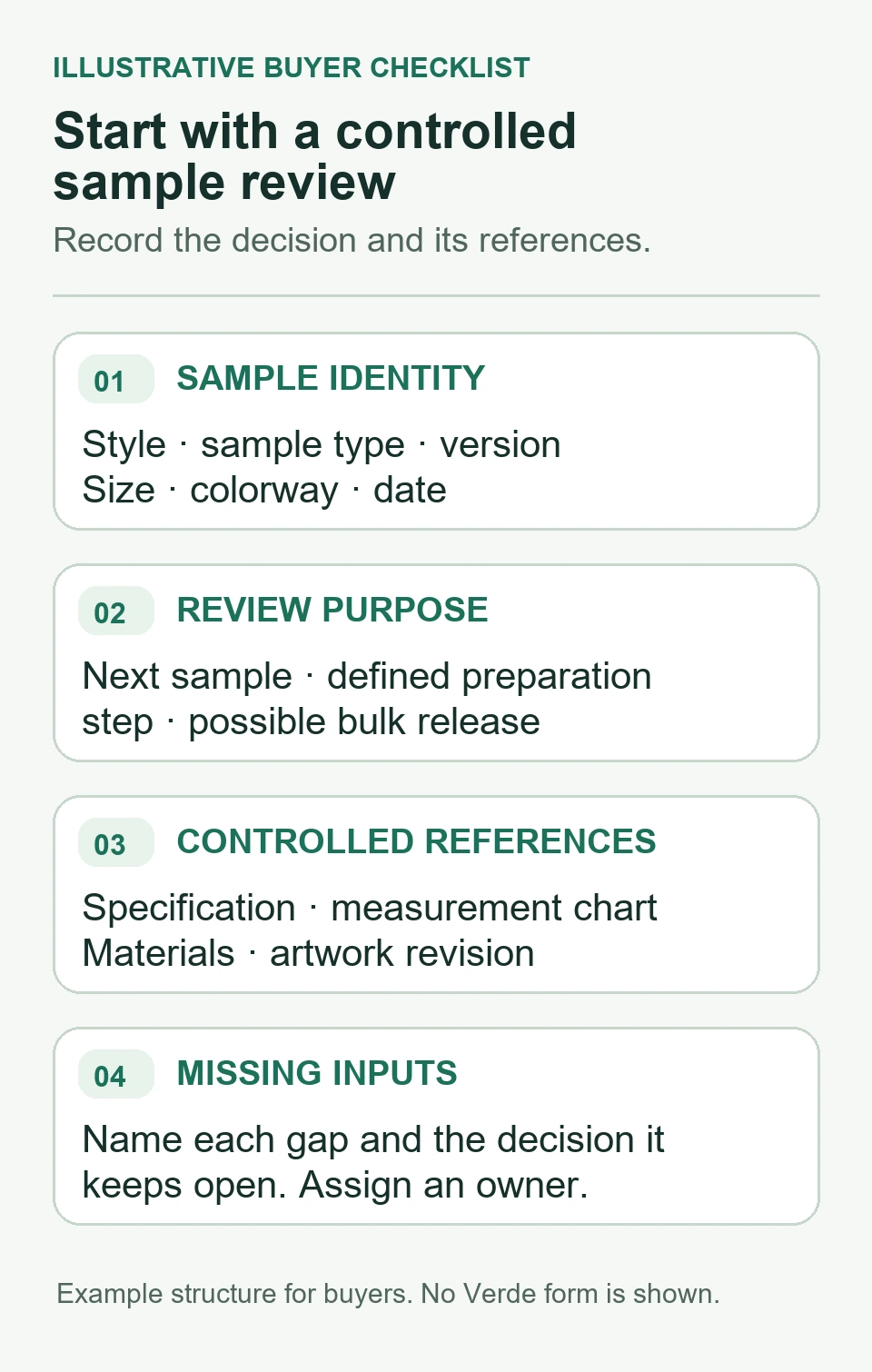
Identify the sample type, version, colorway, date, and intended decision
Start by agreeing what this sample is intended to establish. A development review may resolve construction choices; a size set review may support a broader size decision. State whether this round authorizes another sample, a defined preparation step, or bulk release.
Create an intake record containing:
- Style identifier, sample type, version, size, colorway, and date.
- Intended review decision and the person authorized to approve it.
- Known substitutions, missing items, and unresolved earlier comments.
Freeze the specification, measurement chart, material reference, and artwork version
Attach the applicable specification revision, measurement chart, material references, and artwork version to that record. Ask both parties to confirm the same set. Preserve later changes as dated revisions. Reviewing an older sample against newer instructions can make comments inapplicable to the unit received.
For the wider development sequence, see Verde’s guide to pet clothing manufacturing.
Record missing inputs before evaluating the physical sample
Mark each missing reference and the decision it prevents. You can inspect visible finishing while an artwork file is pending, but artwork approval remains open. Agree who supplies each missing input before drawing conclusions about that feature.
Review Measurements, Size Logic, and Intended Fit
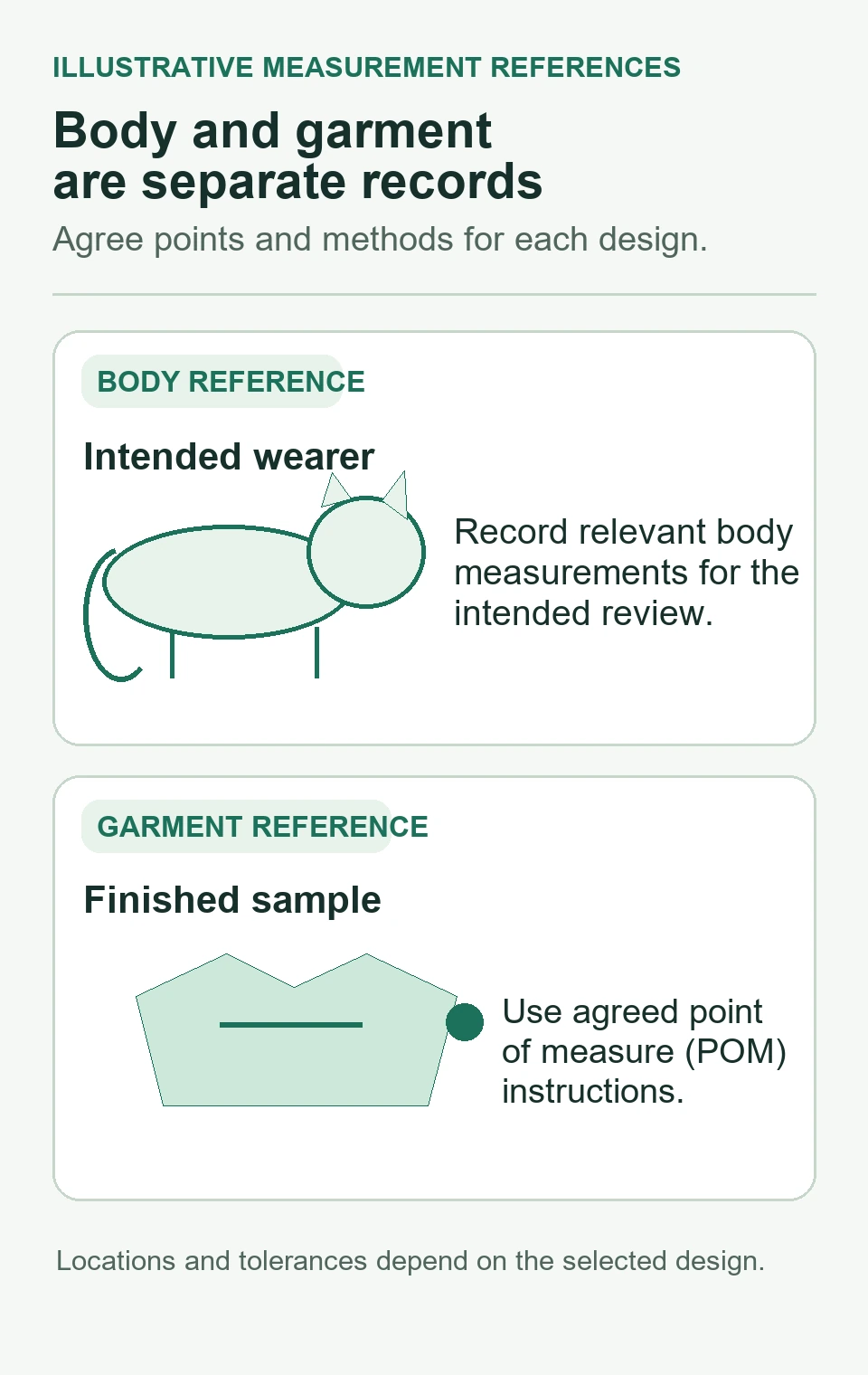
Separate body measurements from finished garment measurements
Body measurements describe the intended wearer. Finished garment measurements describe the physical sample. Keep them in separately labelled records. Any relationship between the two, including intended ease or coverage, needs to be defined for the design. A size name alone gives insufficient detail for that comparison.
Use consistent points of measure and project specific tolerances
For each point of measure, confirm its start and end locations, units, garment position, and measurement method. Specify whether the garment is laid flat, which closures are fastened, and whether elastic is relaxed. Follow the agreed instructions consistently on both sides of the review.
Record the target, actual measurement, difference, and applicable project tolerance. Resolve unclear instructions before classifying a difference as acceptable. Request the agreed tolerance table wherever acceptance depends on it.
Check size and grading evidence before wider approval
Identify the reference size and the sizes covered by the proposed decision. Request the relevant size chart, grading progression, and agreed size set evidence. Check that corresponding measurements and opening positions follow the intended design across the reviewed sizes. Keep unreviewed sizes explicitly outside approval until the agreed evidence is available.
If the proposed order includes several sizes, list which physical samples or measurement records support each size. A missing size record should remain visible in the decision, with an owner assigned to provide it.
Observe intended fit, coverage, movement, and closure placement in context
Where product specific wearer observations are part of the review, record the cat’s relevant body measurements, sample size, intended use, and observation conditions. Review coverage, opening positions, closure placement, and movement shown in that evidence. Note visible pulling, shifting, or contact that requires further assessment.
Keep comfort observations specific to the recorded review. Missing or inconclusive evidence leaves intended fit unresolved; it provides no basis for universal comfort, safety, or movement claims.
Compare Materials, Components, and Construction With the Specification
Verify fabric, lining, elastic, closures, trims, and component identity
Compare outer fabric, lining, elastic, closures, trims, reinforcement, and other components with the approved material list and reference samples. Check reference codes, specified colors, visible structure, dimensions, and documented composition where required. Record unavailable references and any declared substitution separately.
Handle and appearance can inform comparison with a physical reference. Keep material identity tied to the agreed documentation, particularly when two visually similar components are being considered.
Check construction details and component placement against the controlled reference
Follow the garment around its openings, closures, and panel joins. Compare the construction arrangement, lining coverage, reinforcement locations, and component positions with the drawing or specification. Confirm which details are provisional. Identify any feature that needs a clearer drawing before the supplier can reproduce the intended arrangement.
Request test evidence only when the specification requires a performance decision
If approval depends on a stated performance requirement, request the applicable method, acceptance criterion, and evidence linked to the relevant product or material. Check that the evidence covers the version under review. Leave that requirement open until the agreed evidence is available. This material comparison alone establishes no performance result.
Inspect Workmanship, Branding, Labels, and Packing Details
Record stitching, seams, attachments, symmetry, and visible finishing issues
Inspect the inside and outside under conditions that make the details visible. Work through these practical checks:
- Stitching and seams, including visible gaps, uneven stitching, puckering, or unfinished edges.
- Attachments and closure assembly, including loose or incomplete visible attachment points.
- Symmetry and alignment where the design calls for matching sides.
- Finishing, including loose threads, exposed ends, or inconsistent edge treatment.
Locate each observation on the sample and compare it with the agreed construction reference. A photograph should show both the overall location and the detail requiring attention.
Compare print, embroidery, logo position, artwork, and color references
Use the controlled artwork to review logo size, orientation, placement, and the execution of print or embroidery. Compare colors using the agreed color reference and review conditions. If a photo is the only available evidence, record that limitation before closing the color decision. Check placement relative to defined garment points so a requested correction is measurable.
Review labels, identification, and packing examples included in the sample scope
Check the agreed label text, size identification, placement, orientation, and attachment. For an included packing example, compare the specified folding, individual packing, identification, and assortment details. Mark absent packing elements as unreviewed. If destination requirements remain unresolved, assign their confirmation separately before approving the affected label or packing detail.
Turn Sample Comments Into a Controlled Revision Record
Use marked photos and precise observations for each issue
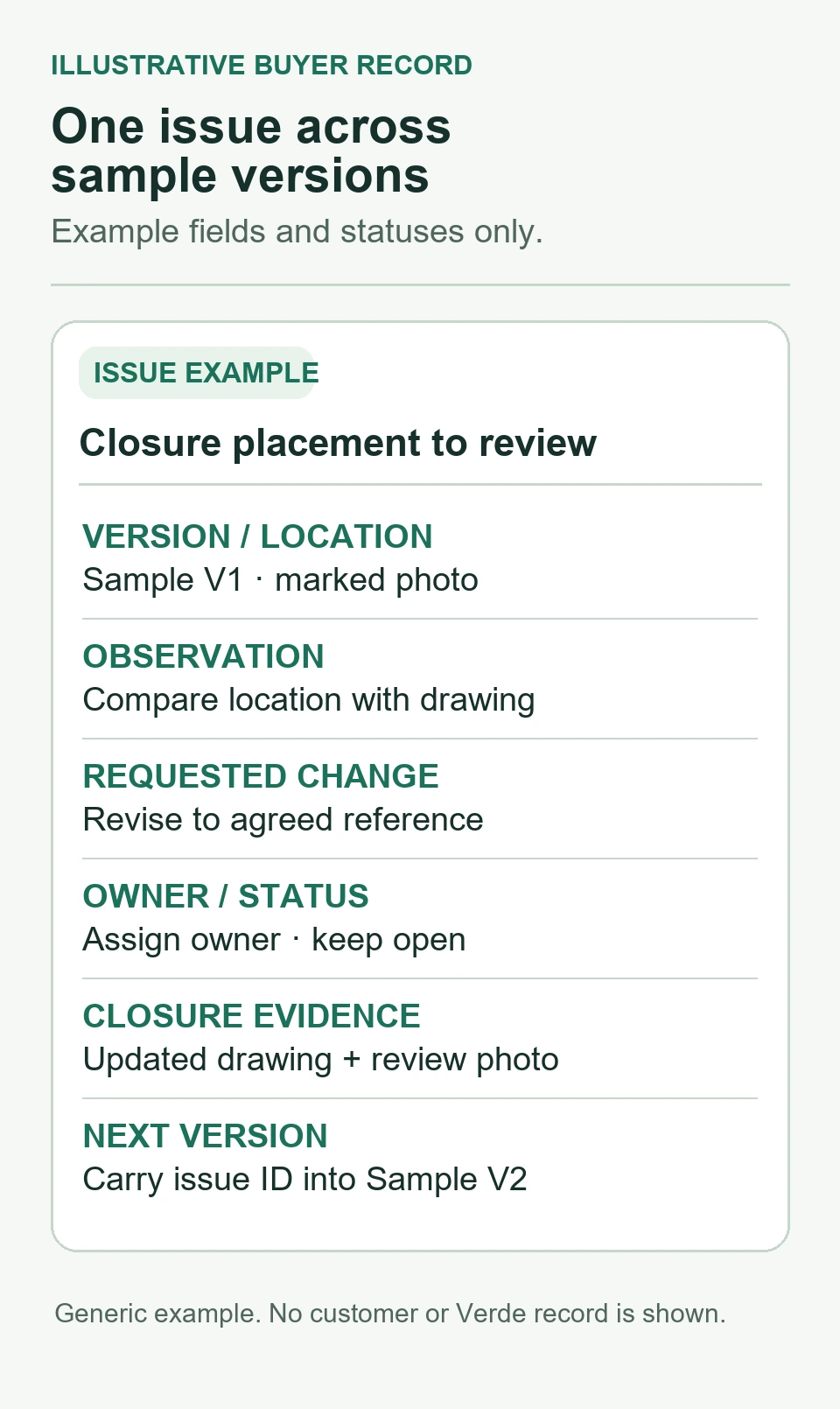
Give each issue a stable identifier and link it to the sample version, location, and marked image. Describe the observed difference and cite the controlling reference. For example, an illustrative comment could identify a closure positioned away from the location specified in the drawing. Include the actual and required positions where those have been measured.
Assign the requested change, priority, owner, status, and due date
A useful buyer record contains the requested revision, priority or severity, responsible party, open or resolved status, due date, and next action. Explain how the issue affects the next decision. Agree which evidence will demonstrate closure, such as a revised drawing, marked measurement record, or replacement sample.
This is an illustrative buyer method. Its fields have no verified status as a Verde internal form.
Carry open and resolved issues into the next sample version
Retain issue identifiers when the next sample arrives. Recheck each requested correction and record its resolution evidence and reviewer. Carry unresolved items forward explicitly. Keep previous comments accessible so a new version does not erase earlier decisions or reopen a settled detail without explanation.
When a correction changes a related feature, review that effect as well. Moving a closure, for example, may require checking its position against both the drawing and the corresponding opening measurement in the revised sample.
Choose Approved, Conditionally Approved, or Revision Required
Define each outcome through open issues, responsibilities, and next action
Agree the operational meanings for the project:
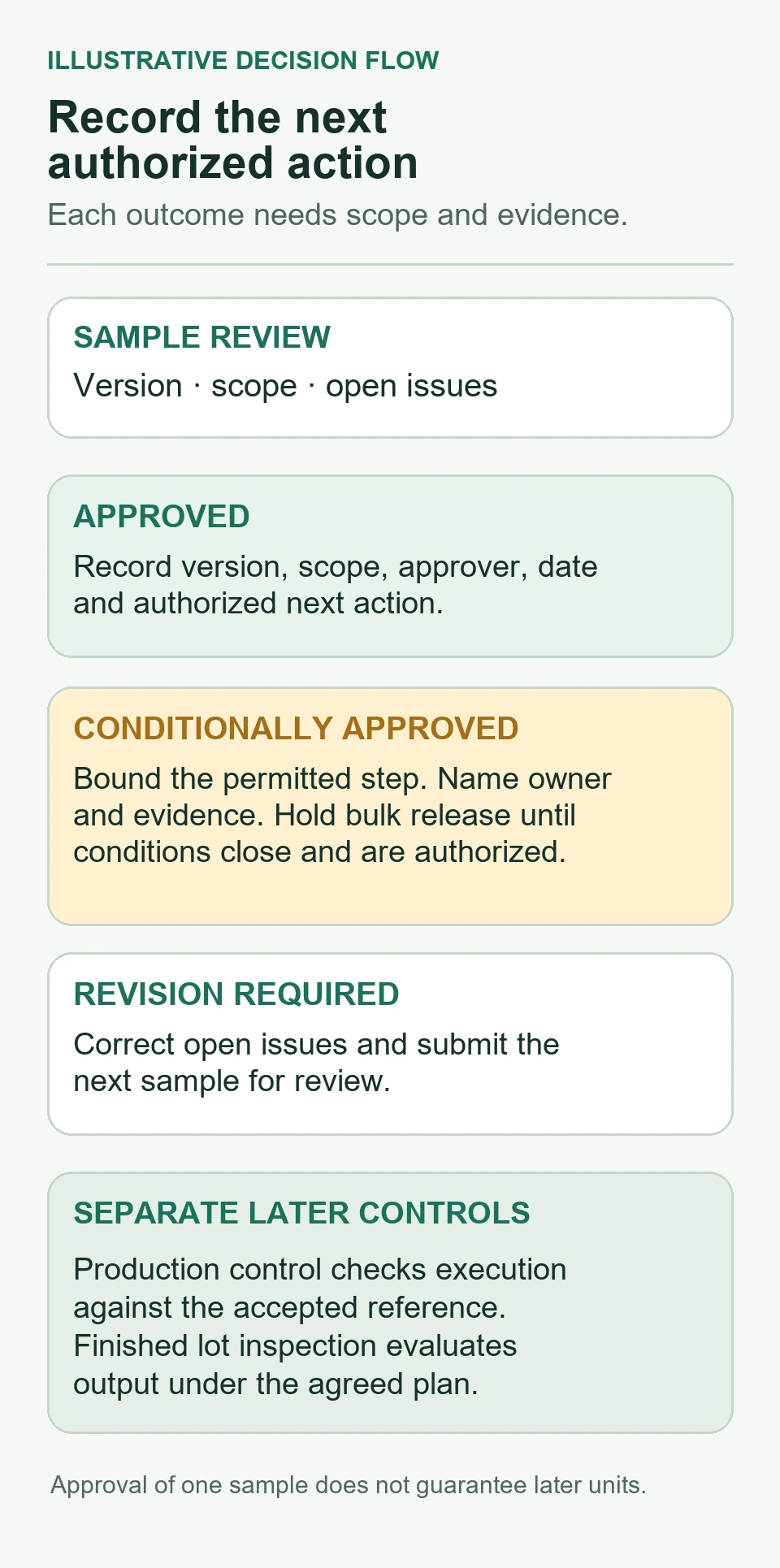
- Approved: No unresolved issue blocks the agreed next stage. Record the version, scope, approver, date, and authorized action.
- Conditionally approved: A defined next step is accepted subject to explicit conditions. Record each condition, owner, required evidence, and release rule, including any work that must wait.
- Revision required: Remaining issues require correction or another sample review before release. Specify the next submission and review scope.
These are project control descriptions with terms to be agreed by the parties. Conditional approval needs an explicit boundary around the permitted action.
For example, the buyer could accept a defined preparation step while a corrected label remains pending. Record who will review the replacement label and specify that bulk release waits for that review. This makes the condition actionable for everyone receiving the decision.
Close release critical issues before bulk production
Before authorizing bulk release, confirm closure evidence for measurements, materials and components, artwork, branding, labels, sample comments, and packing within scope. Confirm the final sample version and covered sizes and colorways. Any required fit or performance evidence must also be resolved. Have the authorized buyer record the release decision and its date.
Preserve the approved sample and controlled documents as the working reference
Identify the retained sample and store its approved documents and comment history together. Verde’s published project workflow describes the approved sample as a working reference for construction, measurements, materials, components, and finishing. Confirm the specific reference and production arrangements for your project.
Separate Sample Approval From Bulk Production and Lot Inspection
Explain what the approved sample controls during production
The approved sample provides a comparison reference for the agreed product details. Record its scope alongside the controlled documents so production teams can identify the accepted construction and finish. Any later change needs its own documented review and authorization.
Explain why one approved unit cannot guarantee bulk consistency
Evidence from one approved unit covers that unit and the stated review. Bulk output still requires checks against the reference. Keep the approval decision separate from conclusions about later units, and agree how production differences will be reported and resolved.
Keep production controls and finished lot inspection in their proper roles
Keep three layers explicit. Sample evaluation establishes the accepted reference. Production control monitors execution against it. Finished lot inspection evaluates output under the agreed inspection plan. AQL belongs to the lot inspection discussion; ISO 2859-1:2026 covers acceptance sampling by attributes using AQL indexed plans for lot by lot inspection.
Before proceeding, the buyer should hold a traceable reference, a resolved or bounded comment record, and written authority for the next stage.
Discuss Your Cat Clothing Sample Review with Verde. Share the available sample type and version, photos or drawing, specification or tech pack, measurement chart, material and component references, artwork, branding and label details, target market, target quantity, size mix, current comments, and unresolved issues. Available inputs can begin the discussion; project feasibility remains subject to review.