

Online shopping is no longer “growing fast.” It is becoming habitual.
Europe’s e-commerce sector is entering a consolidation phase. Growth is no longer driven primarily by new adopters. Instead, it is driven by frequency.
According to the Geopost E-Shopper Barometer, 77% of Europeans shop online in 2025, only slightly up from 76% in 2023.
The real shift lies elsewhere:
Regular online shoppers — defined as consumers purchasing at least once per month — increased from 48% to 52% in the same period.
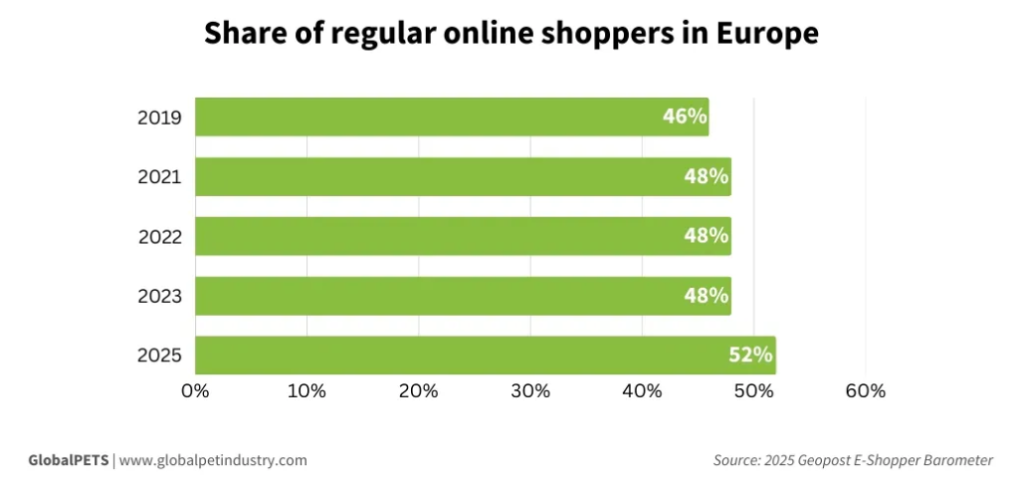
These regulars account for 89% of all online purchases analyzed.
The market is not just expanding. It is stabilizing into routine behavior.
Where Does Pet Fit in Europe’s Online Landscape?
The Geopost study, based on 30,697 respondents across 22 countries, ranks product categories purchased online.
Food, beverages and groceries — including #petproducts — rank sixth and seventh, with:
- 35% of respondents buying these categories online
- 32% purchasing food and beverages at least once per week
- 58% purchasing at least once per month
Earlier in 2025, Geopost forecasted significant demand growth for fresh #petfood across multiple market segments.
#Petretail is no longer a “secondary” online category. It is becoming part of consumers’ routine replenishment cycle.
Online Consolidation in Pet Care
NielsenIQ’s September analysis confirms similar consolidation patterns within the #petcategory.
According to Andrea Binder, VP and Pet Industry Insights Leader at NielsenIQ, online channels are “driving double-digit growth.”
Some segments show channel divergence:
- Bedding accessories and pet repellents are growing online
- These same categories are declining in physical stores
However, performance is not purely digital.
Binder emphasizes that 82% of #petcare spending now comes from consumers who buy both online and in-store.
Omnichannel is not optional — it is dominant behavior.
Country-Level Signals
Several national surveys reinforce the broader European shift:
- United Kingdom: Internet is the primary pet food purchasing channel (39% dog owners, 43% cat owners)
- France: Online ranks second (35% for both dogs and cats)
- Italy: 69% of #petowners made at least one online pet purchase in the past 12 months
Italy also shows rising purchasing frequency: monthly online buyers increased from 52% in 2021 to 58% in 2025.
This mirrors the broader European regular-shopper trend.
Diversification and Cross-Border Expansion
European e-commerce baskets are expanding in complexity.
Average product categories per purchase rose from 5.9 in 2023 to 6.2 in 2025.
Cross-border purchasing is also rising:
- 63% of consumers now buy from foreign e-commerce platforms
- Up 5 percentage points since 2023
Top origin countries:
- China (48%)
- United States (29%)
- Germany (26%)
Cross-border buying is no longer niche — it is mainstream behavior.
Out-of-Home Delivery Is Reshaping Logistics Expectations
Europe is seeing a notable shift toward Out-of-Home (OOH) delivery networks.
Preference for parcel lockers increased from 23% in 2023 to 27% in 2025, overtaking parcel shops and post offices.
Home delivery remains dominant overall, but preference declines among younger generations, particularly Gen Z.
For categories like pet food — bulky, heavy, repeat purchase — flexible pickup options are becoming strategically relevant.
Social Media: Conversion vs Inspiration
Direct social commerce usage remains limited:
- Facebook: 22% “usually” purchase via platform
- Instagram: 19%
- YouTube: 15%
52% of respondents do not use social media for direct purchasing.
However, conversion metrics tell a different story.
TikTok and Instagram achieve a 41% conversion rate when used as traffic drivers.
For inspiration:
- Instagram: 36%
- Facebook: 32%
- YouTube: 31%
- TikTok: 25%
- Pinterest: 15%
Social media may not close every sale — but it strongly influences discovery.
What This Means for #PetBrands
Three structural realities define the European online #petmarket:
- Frequency is more important than penetration
- Omnichannel behavior dominates spending
- Cross-border and logistics flexibility influence conversion
Brands entering or scaling in Europe must plan for:
- Routine replenishment purchasing
- Integrated offline-online strategies
- Cross-border compliance and delivery capability
- Platform-driven discovery funnels
The European e-commerce market is no longer experimental. It is operational.
What This Means for Pet Brands Working with OEM Partners
For OEM-driven brands, this shift affects production strategy:
- SKU planning must account for replenishment cycles
- Packaging must align with locker delivery and logistics efficiency
- Inventory agility becomes critical as cross-border demand expands
- Production scalability must support both marketplace and retail channels
As e-commerce matures, manufacturing discipline becomes a competitive differentiator.
At Verde Pets, we view OEM collaboration not only as a supply solution, but as infrastructure alignment for omnichannel growth.
Source: GlobalPETS