
In today’s world full of uncertainties, not all trends are worth focusing on—we need to seize the most important and widely influential ones. Euromonitor International has released the white paper “Five Cross-Industry Transformation Trends for 2026: Reshaping Strategy and Growth.” This article will break down these five core trends in detail, helping enterprises understand and grasp future market directions to maintain competitiveness in the coming year.
The five trends are:
- Next-Gen Online Retail: Optimizing shopping experiences and market entry strategies
- Beyond Low Prices: Breaking price positioning to deliver and realize value-added services
- Market Volatility: Uncovering growth opportunities and managing risks in a turbulent economy
- Path to Longevity: Understanding health needs across different life stages to accurately match diverse demands
- Purpose-Driven Consumption: Integrating product innovation with emerging consumption scenarios and demand states
This is the first installment, providing an in-depth interpretation of “Next-Gen Online Retail.”
Next-Gen Online Retail
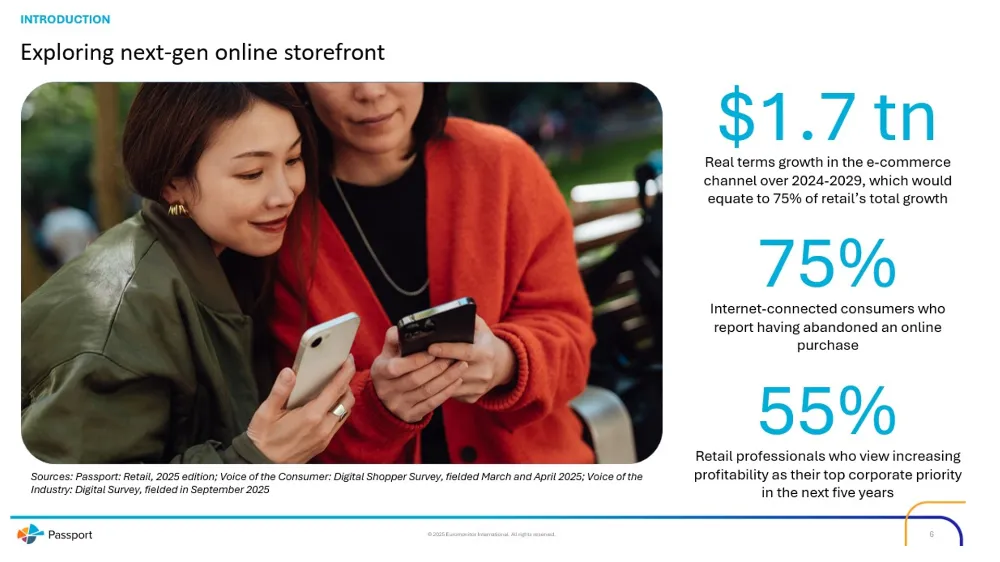
Although e-commerce is expected to account for 75% of retail growth between 2024 and 2029, profitability remains a barrier. Retailers and brands must optimize their online strategies to stay competitive amid industry, consumer, and technological developments—thus leveraging long-term channel shifts and driving sustainable e-commerce growth. The savviest businesses are embracing new product discovery channels, interactive tools, and ways to serve consumers. While these changes have been ongoing for over a decade, online experiences are reaching a tipping point as technological advancements usher in the next generation of online stores.
Generative AI Delivers Smoother, More Personalized Shopping Experiences
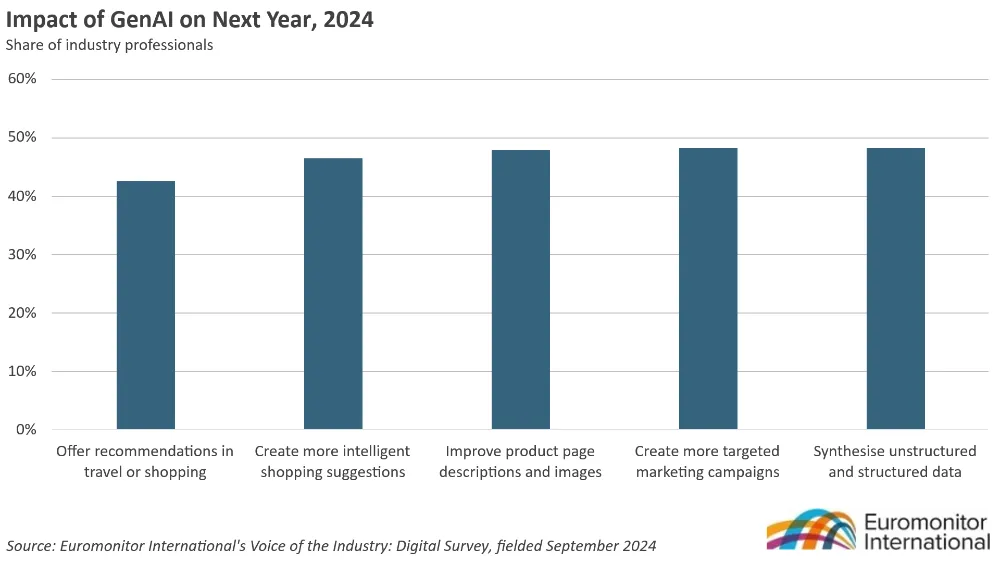
The growing influence of digitalization throughout the shopping journey is forcing enterprises to enhance online experiences. In 2024, generative AI emerged as a technology with the potential to play a key role, as it can deliver exceptional experiences at scale. For example, it can be integrated into the core of brand apps to create tailored landing pages, product descriptions, and illustrations.
According to Euromonitor International’s “Voice of the Industry: Digital Survey” conducted in September 2024, half of industry professionals stated they plan to invest in generative AI over the next five years.
Walmart, the world’s largest retailer, announced it will accelerate its strategy to create a unique homepage for every consumer. The enhanced website is expected to launch in the U.S. by the end of 2025. It will use underlying technology to provide personalized recommendations in Canada, Mexico, and the U.S. Walmart aims to combine generative AI, augmented reality, and personalization technology to create immersive shopping experiences across its Walmart Supercenters, Sam’s Club locations, and virtual environments.
AI Agents Will Take the Lead in Customer Service
In its initial iterations, AI has served as an assistant to human customer service representatives by providing faster, more accurate responses. Generative AI can go further—suggesting replies, summarizing past interactions, and flagging follow-up actions. Now, AI agents can independently trigger workflows and resolve customer issues without human intervention. While still in the early stages of development, these technologies are expected to deliver more human-like bot experiences. Given that AI agents can independently select the best actions to achieve human-set goals, this next phase of development is likely to be transformative.
At the end of 2024, Zalando, a German specialty fashion retailer, launched an AI fashion assistant in 25 countries. Powered by its own models and OpenAI’s large language models, Zalando’s AI assistant allows logged-in customers to receive personalized fashion advice in their preferred language. This generative AI tool can guide customers through highly fluid, personalized prompts—unlike traditional search methods that rely on recalling web content.
Tech Advancements Demand More Flexible Market Entry Strategies
As online product exposure channels multiply—such as e-commerce platforms, DTC websites, and social media—market entry strategies have become more complex. Nestlé, one of the brands with the highest online penetration, has built a category-centric e-commerce strategy, matching each brand with the best channel. For example, in the U.S., data shows key retailers for each brand include Chewy (a pet specialist) for Purina, DTC channels for Nespresso, and Walmart (a grocery retailer) for Stouffer’s.
Exploring more channels means retailers and brands must deploy more sophisticated strategies to reach their audiences. Beyond identifying the right channels, they must also consider how new technologies will change the entire consumer journey—from search to final purchase.
Retailers and brands must ensure their inventory, pricing, and product information are optimized to align with decision-making AI algorithms. In the future, AI agents may also drive more simple, routine purchases—products that require less consideration, such as Nestlé’s mainstream pet food. As the future form of AI agents as personal shopping assistants becomes clearer, enterprises must develop corresponding strategies—how to view these AI assistants and whether they should invest actively.