

In-depth analysis of pet food data from Latin American countries
Trends from Data
As pets continue to gain prominence in household spending, Latin American families are spending more on their pets than on everyday necessities at a visible rate.
According to data from Worldpanel, a subsidiary of Numerator, cited by GlobalPETS, the market share of pet food in Latin America is projected to grow by 6% by 2025, exceeding the 4% year-on-year growth of basic pet food .
E-commerce channels are experiencing exponential growth, with online sales of pet food soaring from $25 million at the beginning of 2023 to $82 million at the end of 2025 , more than doubling in three years .
E-commerce penetration has also climbed from 3.9% at the end of 2023 to 6.7% in 2025. Although it may not seem high, in total FMCG (Fast Moving Consumer Goods) spending, pet food’s share has increased from $1 billion to $1.3 billion , a full 30% increase .
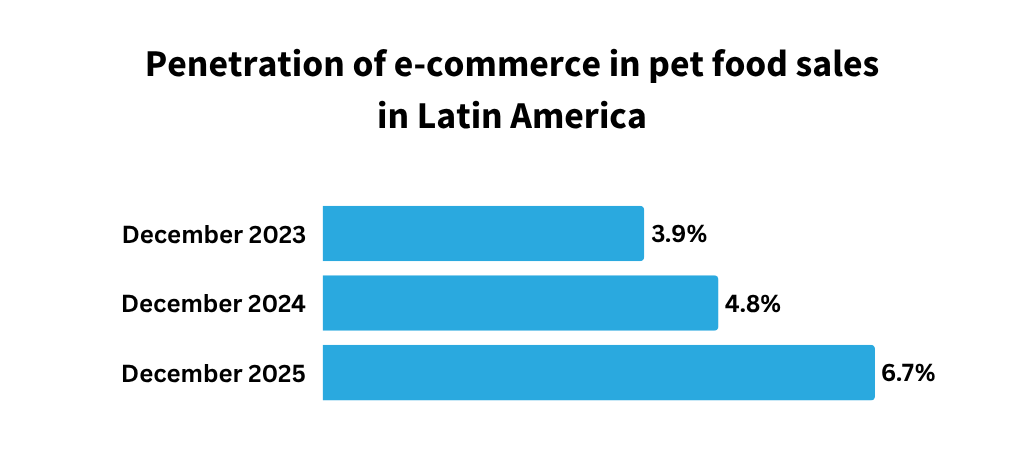
Data source: Worldpanel by Numerator, the same below.
Clearly, the growth rate of the Latin American pet food market is enough to make any #petbrand stop and study it seriously .
Differences from a national perspective
Mexico has the largest economy, but its e-commerce sector lags behind . A survey found that 9 out of 10 Mexican households buy pet food, but e-commerce penetration is significantly lower, at only 3.5%, far below the Latin American average.
This means that Mexico is a market where traditional channels are extremely mature, but online channels are not yet fully developed . Worldpanel expert Nacira Barraza analyzed: “We believe that e-commerce penetration in Mexico, especially in the pet food sector, is still seriously insufficient and has huge growth potential.”
For pet brands looking to enter the market, the opportunity in Mexico lies not in teaching consumers ” whether or not to buy pet food , ” but in ” where to buy it . ” Once driven by e-commerce infrastructure and established consumer habits, the potential is enormous.
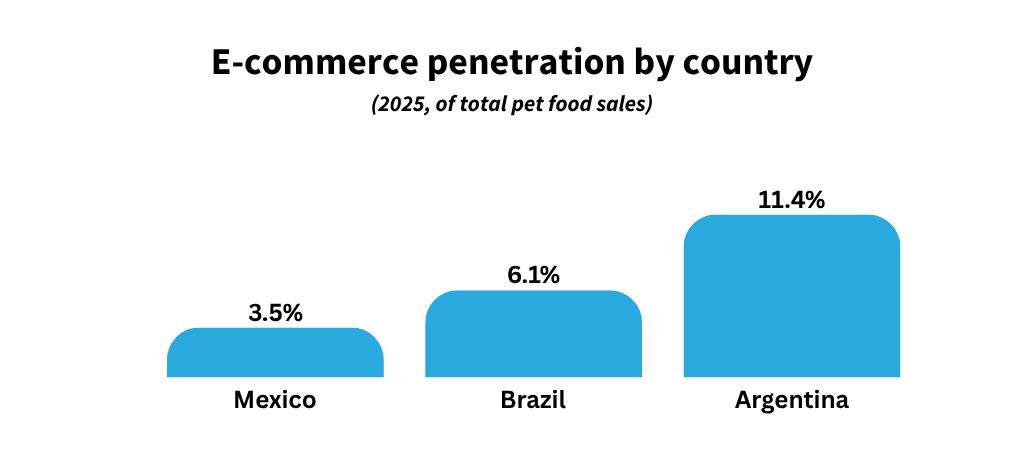
Brazil is the second largest market, with a relatively mature e-commerce market and a penetration rate of 6.1%.
This is mainly due to the increasing number of families shifting from homemade food to packaged pet food, coupled with the fact that markets and pet specialty stores are actively embracing digitalization.
If you want to enter the Latin American market, Brazil might be the most suitable market to test as a primary e-commerce channel. Consumers are already used to buying pet food online; your job is to impress them with your product.
Argentina’s market isn’t large, but e-commerce is its strongest sector . E-commerce penetration is highest in pet food, reaching 11.4%, nearly double the Latin American average.
Moreover, it’s not just pet food; Argentina’s e-commerce sector is highly developed across the board. This indicates that Argentine consumers have a high acceptance of online shopping.
For brands, Argentina is more like a testing ground for an ” elite force ” model —a small market with a high conversion rate, suitable for honing e-commerce operational capabilities, and then replicating it to a larger market once it’s proven successful.
Opportunities from Channels
Don’t focus on just one country; instead, stratify your strategy based on ” e-commerce maturity . ” For example:
Argentina is prioritizing e-commerce testing . It boasts the highest penetration rate and the best online shopping habits among its consumers. This allows for DTC (direct-to-consumer) strategies or testing of products and operational models on leading platforms like Mercado Libre. Risks are manageable, and data feedback is rapid.
Brazil is a good place to scale up e-commerce . The infrastructure and consumer habits are in place, so you can increase investment and replicate the successful model from Argentina.
Mexico is adopting an ” online + offline ” approach . Don’t expect pure e-commerce to penetrate the market in the short term, but you can use online channels for brand exposure and new product testing, while offline channels such as supermarkets and #petstores are used for market penetration. Mexico’s offline channels are extremely mature, so don’t waste this advantage.
Chile and Colombia are worth paying attention to . E-commerce is rapidly gaining popularity in these two Latin American countries, which are poised to become the ” next Brazil , ” making them suitable for medium-term investment.
Cross-border e-commerce platform: Meikeduo
Looking at the prospects from the perspective of consumption
Looking at the channels isn’t enough; you also need to see who is buying and what they are buying .
According to Worldpanel data, dry dog food remains the largest category, but treats and wet dog food are experiencing even stronger growth .
Among people aged 65 and above without children, 43% own cats or dogs, and this group contributes 16% of the market value. Data shows that the role of pets in Latin American families is shifting from ” guarding the house ” to ” emotional companionship , ” and those willing to pay for emotional support are less price-sensitive and more demanding in terms of quality and brand .
The declining birth rate has led to pets taking on more emotional roles in families, directly driving the replacement of homemade pet food with industrialized pet food, because people who ” treat their pets as family members ” will no longer feed them leftovers .
Putting all of the above together, the decision-making logic is actually quite clear.
The Latin American pet food market is currently in a window of opportunity characterized by “both increased volume and price, and structural differentiation” .
On the one hand, the total market size is steadily expanding ; on the other hand, structural opportunities such as e-commerce channels, functional products, and high-end consumption are being released at an accelerated pace .
For pet food brands, Latin America is not a market where one trick can guarantee success. A deep understanding of each country’s distribution channels and consumer habits, coupled with a differentiated market entry strategy, may be the right way to tap into this “tropical blue ocean . “