Germany’s pet population recorded another slight decline in 2025, continuing a gradual downward trend seen over recent years.
However, despite softer ownership numbers, overall market revenue remained relatively stable — highlighting the resilience of pet-related spending even in a mature market environment.
According to data from the German Pet Trade & Industry Association and the Industrial Association of Pet Care Producers:
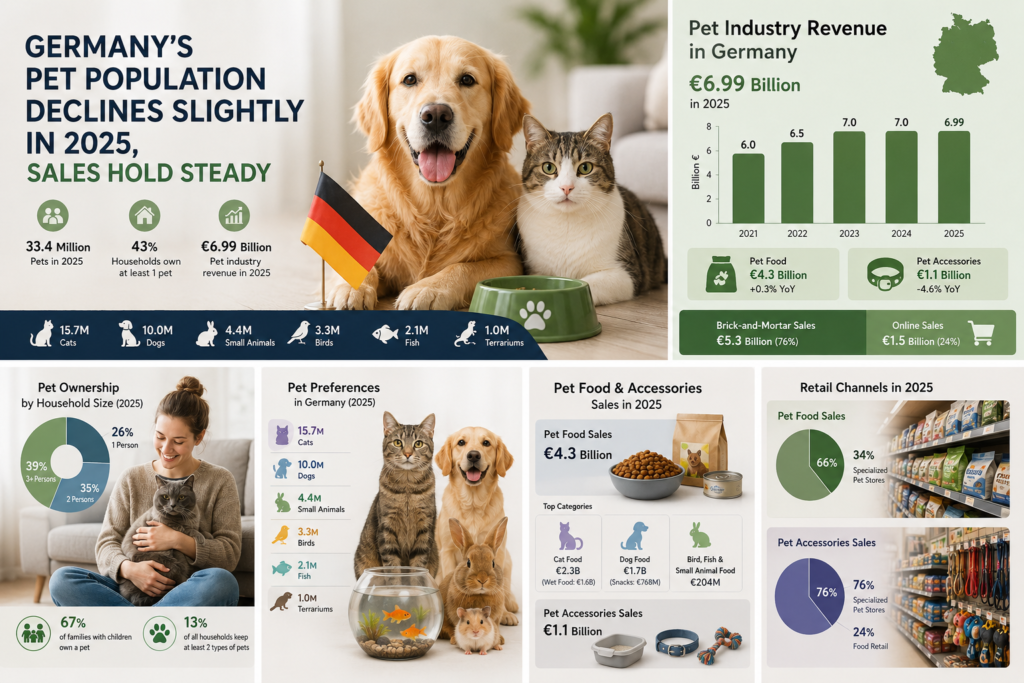
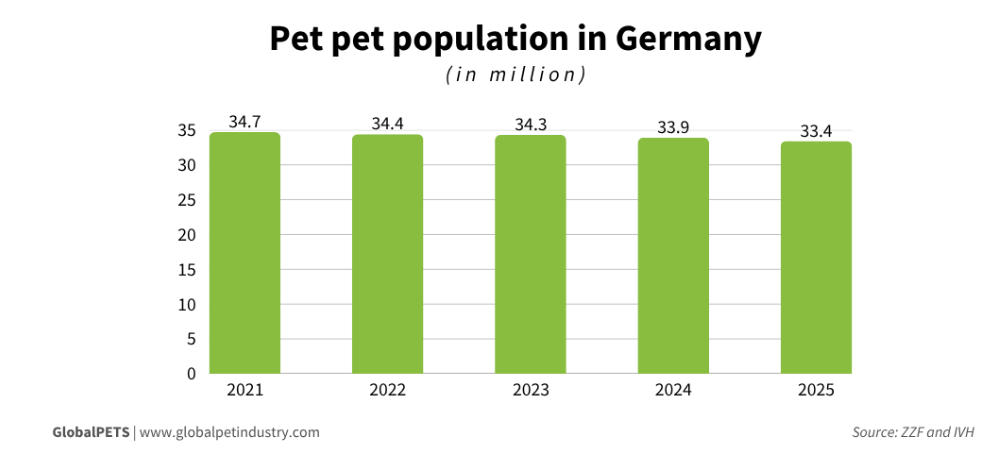
- Germany had 33.4 million pets in 2025 (excluding fish and reptiles)
- 43% of households owned at least one pet
Compared with previous years:
- 2024: 33.9 million pets, 44% household penetration
- 2023: 34.3 million pets, 45% household penetration
- 2022: 34.4 million pets, 46% household penetration
👉 The decline is gradual rather than dramatic.
But it suggests the German market may be entering a more mature and stable phase.
Ownership Trends: Older Consumers and Families Remain Core Drivers
The 2025 study, based on a survey of 5,000 households, reveals clear differences in ownership patterns.
Household Size
Pet ownership distribution:
- Single-person households: 26%
- Two-person households: 35%
- Households with 3+ people: 39%
Families continue to play an important role:
- 67% of households with children owned at least one pet
In addition:
- 13% of households owned two or more types of pets
Older Consumers Represent a Large Share of Owners
By age group:
- 60+ years old: 25%
- 50–59 years old: 21%
Younger ownership rates were lower:
- 30–39 years old: 19%
- 40–49 years old: 18%
- Under 29: 17%
👉 This highlights an important demographic reality:
Older consumers remain a key purchasing force in Germany’s pet market.
Cats and Dogs Still Dominate — Despite Slight Declines
Cats remain Germany’s most popular companion animal.
Cats
- 15.7 million cats in 2025
- Present in 1 out of 4 households
Down slightly from:
- 15.9 million in 2024
Dogs
- 10 million dogs in 2025
- Present in 1 out of 5 households
Compared with:
- 10.5 million in 2024
👉 Even with moderate declines, dogs and cats continue to dominate household pet ownership.
Smaller Pet Categories Show Mixed Performance
Some smaller categories recorded modest growth:
- Small animals:
- 4.4 million
- Up from 4.3 million
- Birds:
- Increased from 3.2 million to 3.3 million
- Fish:
- Increased from 2 million to 2.1 million
Meanwhile:
- Terrariums declined slightly to approximately 1 million
👉 The market is not collapsing —
but ownership growth is becoming increasingly limited.
Revenue Remains Stable Despite Softer Ownership Numbers
One of the most notable findings:
👉 Consumer spending remains resilient.
Germany’s pet market reached:
- €6.99 billion ($8.2B) in 2025
Compared with:
- €7 billion in both 2024 and 2023
- €6.5 billion in 2022
- €6 billion in 2021
👉 The market has largely stabilized at a high level.
Pet Food Continues to Drive the Market
Pet food remains the largest revenue contributor.
Pet Food Revenue
- €4.3 billion ($5B) in 2025
- Up 0.3% YoY
At the same time:
👉 Accessories experienced noticeable pressure.
Accessories Revenue
- Declined 4.6% YoY
- Reaching €1.1 billion ($1.2B)
This reflects a broader market pattern:
- Essential spending remains stable
- Discretionary purchases are becoming more cautious
Online Channels Continue to Expand
Retail channel performance shows ongoing structural change.
Total Sales
- Brick-and-mortar:
- €5.3 billion ($6.2B)
- Online:
- €1.5 billion ($1.8B)
The associations noted:
- Online sales increased 0.6% from 2025
- And are now 26% higher than in 2022
👉 Digital purchasing behavior continues to strengthen, even in a mature market like Germany.
Category Breakdown: Cats Lead Spending
Cat Food
Largest category overall:
- €2.3 billion ($2.7B)
Including:
- Wet food:
- €1.6 billion ($1.8B)
Dog Food
Generated:
- €1.7 billion ($1.99B)
With snacks leading growth:
- €768 million ($899M)
Other Pet Food Categories
Combined sales for:
- Bird food
- Fish food
- Small animal food
Reached:
- €204 million ($239M)
Accessories: Functional Categories Remain Important
Within accessories:
- Cat litter:
- €370 million ($433M)
- Cat accessories:
- €230 million ($269M)
- Dog accessories:
- €200 million ($234M)
Specialized pet retailers remained the dominant channel:
- 76% of accessories sales
👉 Functional and routine-use products continue to anchor spending behavior.
Final Insight
Germany’s pet market is no longer in a rapid expansion phase.
👉 It is transitioning into a mature, stability-driven market.
Key characteristics now include:
- Slower ownership growth
- Stable essential spending
- Greater caution in discretionary categories
- Rising importance of online retail
For brands, this means future competition will likely focus less on market expansion —
and more on:
👉 Value positioning
👉 Product differentiation
👉 Operational efficiency
Source: GlobalPETS