
As global birth rates continue to decline and family structures become smaller, dogs and cats are taking on a far more central role inside households worldwide.
New data collected by PETS International shows that in multiple countries, companion animal populations now significantly outnumber children and young people — in some cases by as much as four times.
👉 This is no longer just a demographic trend.
It represents a major long-term shift in how consumers allocate:
- Time
- Attention
- Emotional connection
- Household spending
And for the pet industry, the implications are substantial.
Opposite Directions: Falling Birth Rates, Rising Pet Ownership
Data from Euromonitor International covering 47 countries across:
- Europe
- Asia
- Oceania
- The Middle East
- North America
reveals two trends moving in completely opposite directions.
Between 2020 and 2025:
- Birth rates declined from 17 births per 1,000 population to 16 per 1,000
- By 2030, projections suggest the rate will fall to just above 15 per 1,000
At the same time:
- The global dog and cat population exceeded 1 billion in 2025
- Up from just over 900 million in 2020
- Expected to surpass 1.1 billion by 2030
👉 The pandemic accelerated these trends, but the divergence appears increasingly structural rather than temporary.
Australia: Pets Already Outnumber Children by Two to One
Australia offers one of the clearest examples.
According to Animal Medicines Australia:
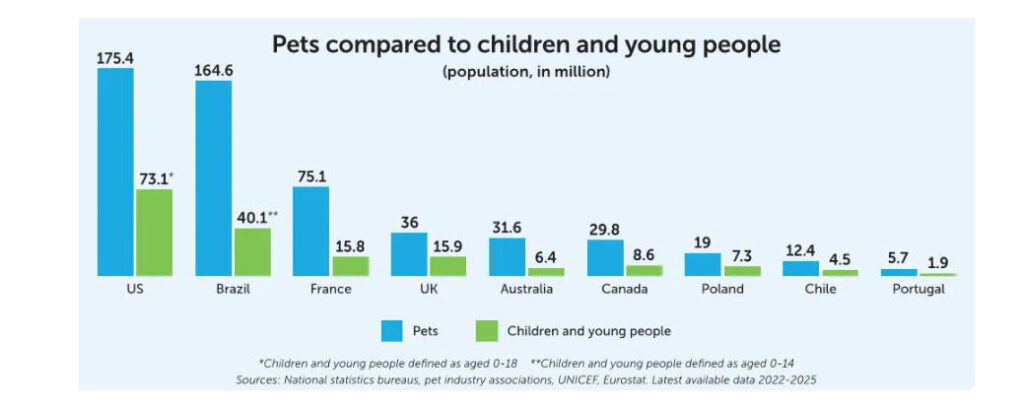
- The country had 31.6 million pets across 7.7 million households as of March 2025
- Dogs and cats accounted for 13.1 million of those pets
By comparison:
- Australia’s population of children and young people stood at 6.4 million in June 2024, according to the Australian Bureau of Statistics
👉 That means companion animals already outnumber young people by roughly two to one.
Growth rates also tell an important story:
- Pet population growth (2022–2025): +10%
- Child and youth population growth (2022–2024): +2.5%
👉 Pet ownership is expanding significantly faster than population growth among younger generations.
Europe Shows the Same Pattern
Across Europe, similar demographic shifts are becoming increasingly visible.
France
According to FACCO:
- France had 75.1 million pets in 2024
- Dogs and cats alone exceeded 26 million
Compared with:
- 15.8 million children and young people aged 0–19, according to Eurostat
United Kingdom
Data from UK Pet Food shows:
- 26 million dogs and cats in 2024
- More than double the UK youth population aged 0–19:
- 15.9 million
Poland
According to FEDIAF:
- Dogs: 8.5 million
- Cats: 7.5 million
Both exceed Poland’s youth population:
- 7.3 million
Portugal
Even in smaller countries like Portugal:
- Total pets reached 5.7 million
- Compared with only 1.9 million young people aged 0–19
👉 Pets now outnumber children by almost three to one.
Similar Shifts Across the Americas
Brazil
According to Abempet:
- Brazil’s pet population reached 164.6 million in 2025
That is roughly four times larger than the country’s child and teenage population.
Meanwhile:
- Youth population declined from 45.9 million in 2010
- To 40.1 million in 2022
Chile
Chile reported:
- 12.4 million dogs and cats in 2022
- Compared with 4.5 million children and teenagers in 2024
United States
According to the American Veterinary Medical Association:
- The US had more than 175.4 million pets in 2025
- Including:
- 87.3 million dogs
- 76.3 million cats
- Including:
Compared with:
- 73.1 million young people under 18 in 2024
At the same time:
- The US youth population declined by 1.7% between 2020 and 2024, according to the United States Census Bureau
Canada
According to Agriculture and Agri-Food Canada:
- Canada had approximately 29.8 million pets in 2024
- Including:
- 8.9 million cats
- 8.3 million dogs
Compared with:
- 8.6 million children aged 19 or under
Why Is This Happening?
Researchers increasingly point to long-term demographic and economic pressures.
A study by the International Monetary Fund notes that fertility rates and population growth are declining across much of the world and are expected to continue falling over the next 25 years.
The IMF projects:
- Global fertility rates currently stand at 2.24
- Expected to fall below 2.1 around 2050
Economic Pressure Is Changing Family Decisions
In June 2025, the United Nations Population Fund published The Real Fertility Crisis.
The report identified major barriers to starting families:
- Financial constraints: 39%
- Job insecurity: 21%
- Housing limitations: 19%
Other concerns included:
- Lack of suitable partners
- Political and social uncertainty
- Changing personal priorities
👉 In short:
Economic pressure is reshaping household decisions globally.
Pets Are Filling an Emotional and Lifestyle Role
According to Sahiba Puri, Global Insight Manager at Euromonitor International:
“People having fewer kids is contributing toward pets becoming the subject of human caregiving.”
She also highlights trends such as:
- DINKWAD households (“double income, no kids, with a dog”)
- Urban isolation
- Single-person households
- Flexible work-from-home lifestyles
👉 Pets are increasingly replacing traditional family structures as emotional companions.
What This Means for the Pet Industry
The implications extend far beyond simple premiumization.
Consumers are becoming:
- More emotionally invested
- More quality-focused
- More demanding about functionality and nutrition
This is accelerating demand for:
- Human-grade products
- Functional health benefits
- Higher-quality nutrition
- Advanced pet care services
According to Euromonitor:
👉 The global pet care industry is projected to grow at a 3% CAGR between 2025 and 2030.
Final Insight
The decline in birth rates and the rise of pet ownership are not isolated trends.
Together, they point toward a long-term structural shift in household priorities.
👉 Pets are no longer simply animals in the home.
They are increasingly becoming:
- Emotional companions
- Family members
- Recipients of time, attention, and discretionary spending
For the pet industry, this means demand will likely become:
- More emotional
- More premium
- More human-centered
And brands that understand this shift early will be better positioned for the next stage of industry growth.
✅ 2️⃣ What This Means for the Pet Industry
The global pet industry is moving into a more emotionally driven phase.
Key shifts include:
- Pets are occupying a more central role in households
- Increased spending on premium and functional products
- Greater demand for human-grade quality and care
At the same time:
👉 Demographic changes are creating long-term structural support for the pet sector.
This is no longer just a short-term consumption trend —
it reflects changing lifestyles and household priorities worldwide.
✅ 3️⃣ What This Means for Pet Brands Working with OEM Partners
The Problem
As pet ownership grows and consumer expectations rise, brands are facing:
- Higher demand for premium-quality products
- Faster product innovation cycles
- Greater pressure to differentiate
- Increasing expectations around functionality and safety
The Need
To remain competitive, brands need:
- Flexible product development
- Reliable product quality
- Faster production response
- Stable and scalable supply chains
Where OEM Partners Create Value
OEM partners can support brands by:
- Developing functional and premium pet products
- Enabling faster product adaptation to market trends
- Supporting small-batch and flexible production
- Ensuring stable quality and supply consistency
👉 In a more human-centered pet market,
supplier capability becomes increasingly important to long-term brand positioning.
Source:GlobalPETS