Pet ownership across Africa is more widespread than many brands expect — but the market remains significantly underdeveloped.
According to Sagaci Research, 29% of Africans aged 18+ own pets, with some countries showing even higher penetration:
- Madagascar: over 40%
- Angola: 39%
- South Africa: 38%
- Kenya: 38%
- Algeria: 35%
👉 This indicates a strong foundation:
Pets are already part of daily life — but spending behavior has not yet fully caught up.
Dogs and Cats Dominate — But Spending Is Still Limited
Among pet owners:
- 54% own dogs
- 47% own cats
Other animals remain niche:
- Chickens: 12%
- Goats: 6%
- Birds: 6%
- Rabbits: 4%
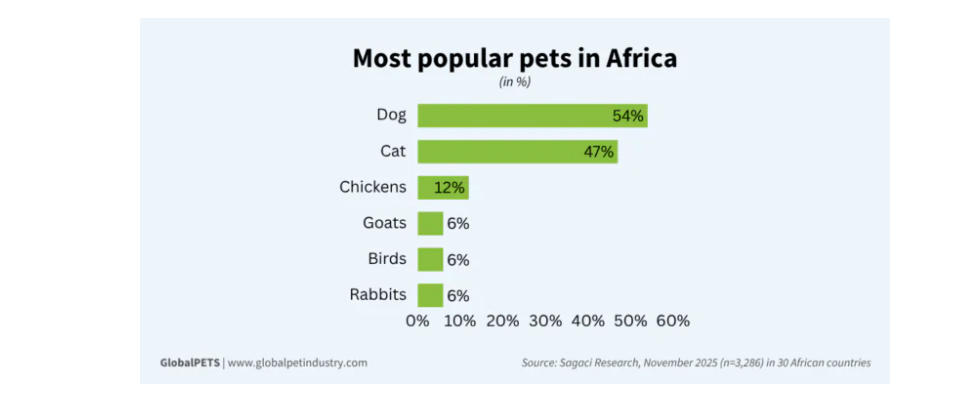
👉 The structure is clear:
The market is heavily concentrated in core companion animals, similar to more mature regions.
However:
👉 Product penetration remains low — especially in commercial categories.
Feeding Habits Reveal the Real Constraint: Cost
When it comes to pet nutrition, the gap between ownership and spending becomes clear:
- 48% feed table scraps
- Only 41% purchase commercial #petfood
Among those who do buy:
- 64% choose dry kibble
👉 This highlights a key issue:
Cost pressure is limiting the shift toward commercial products.
Even among buyers:
- 28% purchase weekly
- 16% every two weeks
- 34% monthly
👉 Purchasing frequency is inconsistent, reflecting budget sensitivity.
Offline Channels Dominate — E-commerce Still Early
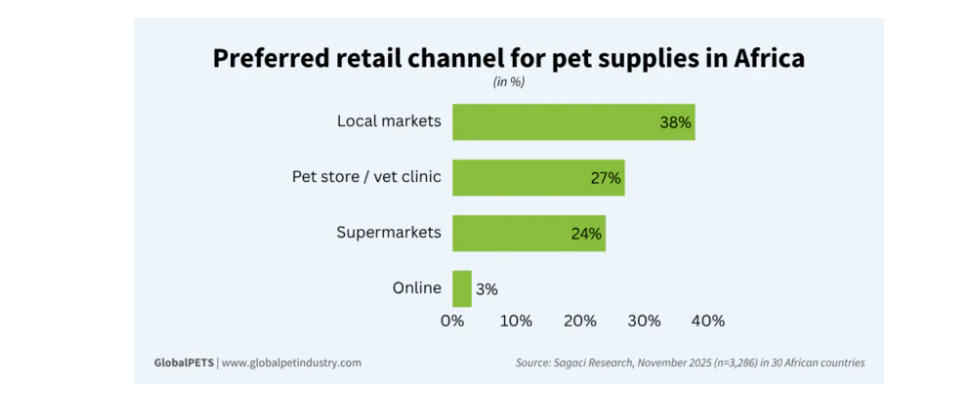
Retail behavior further reinforces the structure of the market:
- Local markets: 38%
- Pet stores / vet clinics: 27%
- Supermarkets: 24%
- Online: only 3%
Even with Amazon launching in South Africa in May 2024, adoption remains limited.
👉 The reason is simple:
Consumers still strongly prefer physical, local purchasing channels.
Local Brands Lead — Global Brands Compete in Select Segments
Brand preference is dominated by local players.
Leading brands include:
- Marltons
- Pamper
Other top brands:
- Nestlé Purina
- Montego Pet Nutrition
- Husky
- Bob Martin & Co
- Bobtail
- Beeno
- Pedigree (Mars Petcare)
- Migliorgatto
👉 This shows a clear dynamic:
- Local brands win on accessibility and price
- Global brands compete on positioning and recognition
Insurance Awareness Remains Low — But Interest Exists
Pet insurance adoption is still in its early stages:
- Only 15% currently have insurance
- 25% are considering it
- 61% have never considered it
👉 This highlights a broader pattern:
Awareness — not just affordability — is a key barrier.
The Real Opportunity: A Market Between Ownership and Spending
Africa’s pet market sits in a unique position:
- High pet ownership
- Low commercial product penetration
- Strong reliance on informal channels
- High price sensitivity
👉 This creates a clear gap:
Between having pets and spending on them.
Final Insight
The African #petmarket is not a saturated market — it is an underdeveloped one.
- Demand exists at the ownership level
- But commercial demand is still emerging
👉 For brands, the challenge is not just entering the market —
but aligning with how consumers actually spend.
✅ 2️⃣ What This Means for the Pet Industry
The African #petmarket reflects a different stage of industry development:
- Ownership is already established
- Commercialization is still limited
- Price sensitivity remains a dominant factor
At the same time:
- Core categories (dogs and cats) are clearly defined
- Offline retail channels dominate
- Consumer awareness is still developing
👉 This suggests long-term potential, but slower short-term conversion.
✅ 3️⃣ What This Means for Pet Brands Working with OEM Partners
The Problem
Brands entering or expanding in Africa face:
- Low penetration of commercial #petproducts
- High sensitivity to price
- Limited adoption of premium or specialized products
- Fragmented retail channels
The Need
To succeed, brands need:
- Cost-effective product solutions
- Flexible product positioning (entry-level to mid-tier)
- Adaptation to offline-heavy distribution
- Ability to scale gradually with market growth
Where OEM Partners Create Value
OEM partners can support by:
- Developing cost-optimized products for price-sensitive markets
- Offering flexible production for smaller or phased market entry
- Supporting product adaptation for local demand patterns
- Ensuring stable supply even in less mature distribution environments
👉 In emerging markets like Africa, cost control + flexibility become critical entry strategies.
Source: GlobalPETS